
Why Smart People Fall for Social Engineering, and Always Will
What the psychology of persuasion reveals about the oldest attack vector in security, and why no amount of intelligence makes anyone immune to it
Ask a room full of security professionals to name the biggest threat to their organization, and a good number will still say social engineering, even after decades of firewalls, endpoint detection and zero trust architecture. This is not because the technology failed. It is because the target of the attack was never the technology. Social engineering succeeds by using the same mental shortcuts that let people function normally in a world that would otherwise be paralyzing to navigate. Understanding why it works requires looking past the specific pretext, the fake IT ticket, the urgent invoice, the friendly voice on the phone, and toward the much older machinery underneath it.
The Six Levers, and Why They Still Work
Cialdini's foundational work on persuasion identified a small set of principles that reliably move people toward compliance: reciprocity, commitment and consistency, social proof, authority, liking, and scarcity. None of these were invented for cybersecurity. They describe how humans have always influenced one another, in commerce, in politics, in ordinary favors between neighbors. Social engineering did not create these levers. It simply pointed them at a keyboard.
Workman's 2007 empirical study, one of the first to test this connection directly rather than assume it, surveyed employees and found that susceptibility to social engineering attacks correlated significantly with the same influence principles Cialdini had documented in offline settings. People who complied with a fabricated request from an "IT technician" were not, on average, less careful or less intelligent than those who resisted. They were responding to the same authority cue that makes people follow instructions from someone in a uniform, or the same reciprocity norm that makes an unsolicited favor feel like it needs repaying. The attack surface was not a knowledge gap. It was a set of well-adapted social instincts operating exactly as they were built to.
Why "Just Be More Careful" Misunderstands the Problem
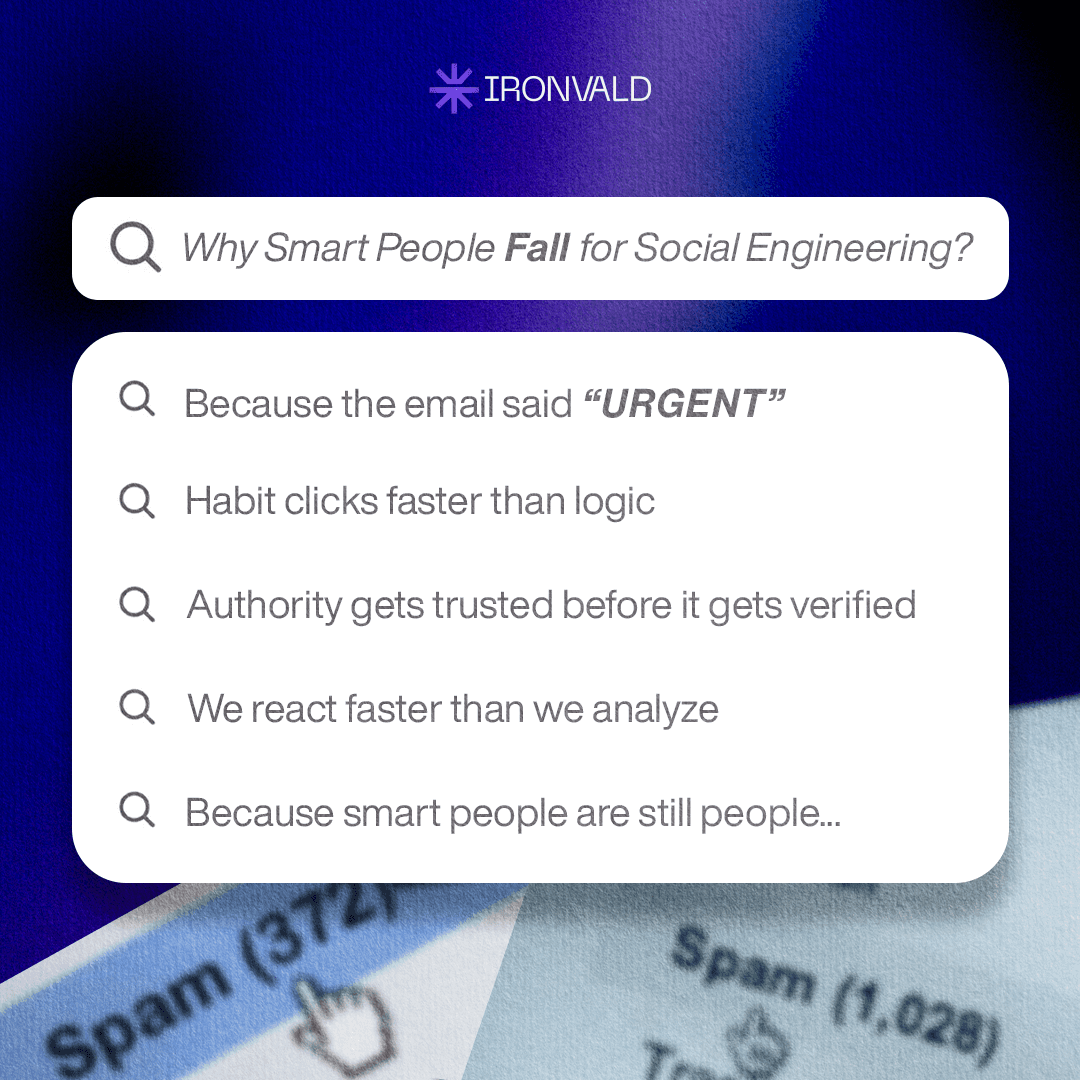
The advice given to employees after a social engineering incident is almost always some version of pay closer attention. This assumes the failure was a lapse in effort, the mental equivalent of not looking both ways before crossing the street. Kahneman's dual-process framework offers a more accurate picture. Most social interactions, including the ones an attacker exploits, are handled by System 1: fast, automatic, and running on heuristics rather than deliberate analysis. A request that arrives with the right tone of urgency, the right appearance of authority, and the right social framing gets processed as routine, not evaluated as a decision. Asking someone to be more careful is asking them to run System 2 on every single interaction of their working day, an approach that is not just unrealistic but actively at odds with how the brain allocates its limited deliberate attention.
Vishwanath, Harrison, and Ng's suspicion, cognition, and automaticity model, developed specifically to explain phishing susceptibility, formalizes this same idea. Their research found that habitual patterns of email use, the automatic scripts people fall into simply from processing large volumes of routine communication, predict vulnerability independently of a person's general awareness or training. The more automatic a behavior becomes, the less available it is for scrutiny in the moment an attacker needs it to be scrutinized. Frequent, repetitive digital habits are not a personal failing. They are what makes the rest of a working day survivable, and precisely what a well-timed pretext is designed to ride on.
Authority Doesn't Need to Be Real, Only Recognizable
Social engineering rarely needs to forge genuine authority. It only needs to trigger the recognition pattern associated with it. Milgram's classic obedience research, conducted decades before phishing existed, demonstrated how far ordinary people would go in following instructions from someone who merely presented as a legitimate authority figure, without any actual power to enforce compliance. The lab coat did the work. In an organizational context, the equivalent lab coat is a spoofed internal email domain, a confident tone on a phone call, or familiarity with internal jargon that makes a caller sound like they belong. None of these require technical sophistication. They require correctly identifying which surface-level cue a given target's brain has learned to associate with legitimate authority, and then producing that cue.
Mitnick's own account of his career as a social engineer, published after his conviction, makes a similar point from the other side of the interaction: the technical barrier was rarely the hard part. The hard part, when there was one, was building a plausible enough story that the person on the other end of the line never had a reason to activate scrutiny in the first place. Deception that never triggers suspicion does not need to survive scrutiny. It only needs to avoid inviting it.
What This Actually Implies for Defense
None of this argues that training and awareness are worthless. It argues that they are aimed at the wrong layer if they assume the fix is simply telling people to think harder. A more productive starting point treats social engineering the way behavioral security research increasingly treats other human-driven vulnerabilities: as a problem of designing the environment around a predictable set of cognitive shortcuts, rather than a problem of insufficiently vigilant individuals.
That reframing has two consequences. The first is that friction should be added deliberately at the specific moments where authority, urgency or reciprocity cues are most exploitable, a callback verification step for any request involving money or credentials, for instance, rather than spread thinly and generically across all communication. The second is that detection has to assume some fraction of these attempts will succeed regardless of how well the friction is designed, because the underlying levers are not flaws to be patched out of the workforce. They are the same mechanisms that let a team function, trust a colleague's request, and get through an ordinary day without treating every interaction as a threat.
The attacker's real advantage was never cleverness. It was patience, and a willingness to let the target's own well-functioning mind do the work of letting them in.
References:
Cialdini, R. B. (2001). Influence: Science and practice. Allyn & Bacon.
Kahneman, D. (2011). Thinking, fast and slow. Farrar, Straus and Giroux.
Milgram, S. (1963). Behavioral study of obedience. Journal of Abnormal and Social Psychology, 67(4), 371–378.
Mitnick, K., & Simon, W. (2002). The art of deception: Controlling the human element of security. John Wiley & Sons.
Vishwanath, A., Harrison, B., & Ng, Y. J. (2018). Suspicion, cognition, and automaticity model of phishing susceptibility. Communication Research, 45(8), 1146–1166.
Workman, M. (2007). Gaining access with social engineering: An empirical study of the threat. Information Systems Security, 16(6), 315–331.
[ Direct Line ]
Talk to Our Security Operations Team
If this briefing is relevant to your environment, our team can assess your exposure and show you how Outis defends critical infrastructure.