
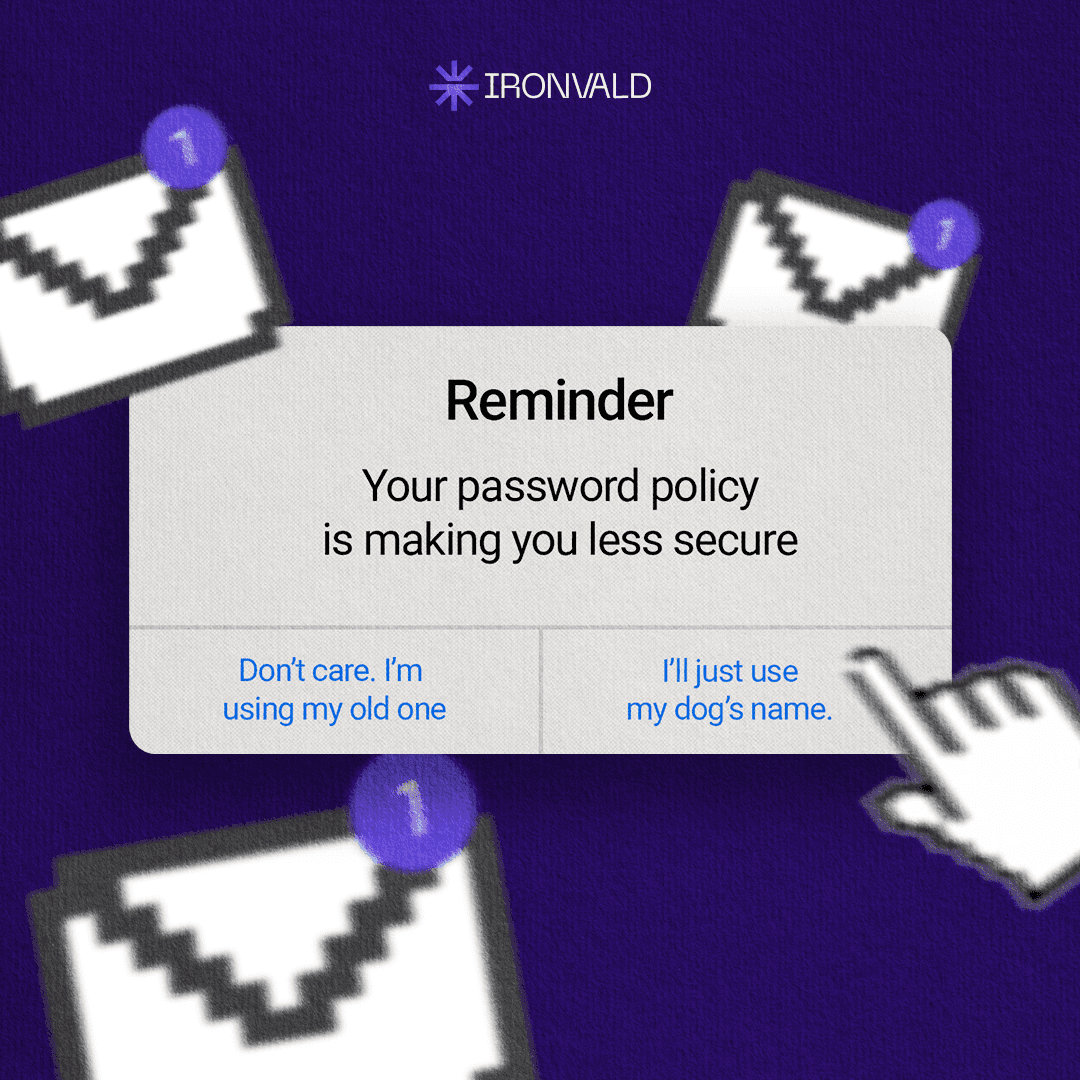
Your Password Policy Is Making You Less Secure
Your Password Policy Is Making You Less Secure: What NIST and Behavioral Science Say
Why decades of security awareness training have failed to change one of our most dangerous habits - and what the science says about fixing it
The average enterprise employee manages somewhere between 70 and 200 passwords. Security teams spend millions on awareness training. Breach after breach makes global headlines. And yet, year after year, "123456" and "password" remain among the most commonly used credentials on the internet. This is a cognitive problem, and the security industry has been treating it as a technical one for thirty years.
Understanding why users consistently make poor password choices, despite knowing better, requires a detour through behavioral psychology, cognitive science, and decision theory. The findings are both illuminating and, for security professionals, deeply inconvenient.
The Intention-Behavior Gap: Knowing Is Not Enough
Knowledge does not predict behavior. This might seem counterintuitive to anyone who has sat through a security awareness session, but it is well-established in psychological literature.
Sheeran and Webb (2016), in a meta-analysis published in Health Psychology Review, demonstrated that the correlation between intention and behavior is far weaker than most people assume, with an average effect size of r = 0.53, meaning intentions explain only about 28% of behavioral variance. Applied to cybersecurity, a user can fully intend to use a strong, unique password and still default to "Fluffy2015!" when the moment comes.
This gap is widened by what researchers call the intention-implementation deficit, the failure to translate a general goal ("I should use better passwords") into a specific plan ("When I create a new account, I will open my password manager first"). Security training, in its traditional form, addresses intentions almost exclusively, and rarely addresses implementation.
The human brain is, at its core, an energy-conservation machine.
Kahneman's dual-process theory, popularized in Thinking, Fast and Slow (2011), distinguishes between System 1 (fast, automatic, intuitive) and System 2 (slow, deliberate, effortful) thinking. Creating and remembering a unique, complex password for every account is a System 2 task. It demands working memory, executive function, and sustained attention. Under cognitive load, which describes the default state of most knowledge workers, the brain reliably reverts to System 1 shortcuts.
Password reuse is a form of cognitive efficiency. Users are not failing the system, rather, the system is failing to account for how the brain actually works. A 2019 study by Wash et al., published in the CHI Conference on Human Factors in Computing Systems, found that users actively develop mental models around password security, and that these models, while internally consistent, are frequently misaligned with actual risk. Users simply reason with incomplete or distorted frameworks.
„Not me“ and „Very me“: Exposed and Hopeful
Perhaps the most persistently dangerous cognitive bias in the security context is optimism bias, the tendency to believe that negative events are less likely to happen to us than to others.
Weinstein (1980) first systematically documented this phenomenon, showing that people consistently rate themselves as less likely than average to experience negative life events. Subsequent research has replicated this finding across health, financial, and security contexts. A Pew Research study found that while most Americans express concern about data privacy in the abstract, they simultaneously underestimate their personal likelihood of being targeted.
This creates a paradoxical communications challenge for security teams. The more impersonal and statistical the warning, the less motivating it is. Telling a user that "billions of credentials are exposed annually" triggers less behavioral change than telling them that someone with their specific email address appeared in a known breach database. Personalization of risk is cognitively necessary, and the industry has been slow to operationalize it.
There is another dimension that security discourse rarely addresses: the emotional one.
Users frequently construct passwords around names of pets, children, partners, and significant dates. From a security standpoint, this is a vulnerability. From a psychological standpoint, it is entirely coherent. Passwords function, at a cognitive level, as a form of self-extension, an expression of identity embedded into a security artifact.
Research on the psychology of personal objects (Belk, 1988, Journal of Consumer Research) suggests that people extend their sense of self into possessions and symbols. Passwords, as private tokens that only the user is supposed to know, occupy a similar psychological space. Instructing users to replace "Bella2009" with "xK8#mP2!qL" is asking them to depersonalize something they have made meaningful. This insight has direct implications for how security teams communicate password policy changes, particularly during onboarding and mandatory resets.
The Industry's Complicity: When Policy Produces the Opposite Effect
Poor password hygiene cannot be attributed entirely to user psychology without examining the role of institutional design.
For decades, password policies have mandated complexity requirements and frequent mandatory rotation. The logic seemed sound. Grassi et al. (2017), in NIST Special Publication 800-63B, presented a landmark reassessment of these practices. The research found that complexity requirements and forced rotation routinely produce predictable, weaker passwords. When forced to change a password quarterly, users increment: "Password1!" becomes "Password2!" becomes "Password3!". When forced to include special characters, they append them to the end. Actual entropy decreases while the appearance of compliance is maintained.
NIST's revised guidelines now recommend length over complexity, discourage arbitrary rotation, and advocate for blacklisting known compromised passwords. Many enterprise systems still enforce policies that NIST has explicitly walked back. This is a governance failure, and auditors and CISOs should be asking hard questions about why legacy policy persists in the face of contradicting evidence.
Toward Behaviorally Informed Security Design
The emerging field of behavioral security, drawing on nudge theory (Thaler & Sunstein, 2008), friction design, and implementation intentions research, offers a more sophisticated framework than awareness training alone.
Reduce friction at the point of secure behavior. Password managers should be pre-installed, configured, and normalized within the organization. Teams that do this see measurably higher adoption than those that merely recommend the tool in a policy document.
Use implementation intentions. Gollwitzer's (1999) research on if-then planning demonstrates that prompting users to form specific plans significantly increases follow-through compared to general goal-setting. Security training that incorporates this structure outperforms traditional awareness formats in longitudinal studies.
Personalize risk communication. Breach notification integrations, Have I Been Pwned lookups, and credential monitoring tools that surface individual exposure are consistently more motivating than aggregate statistics presented in a quarterly report.ž
Design for System 1. Default settings should be secure settings. Opt-in security places a cognitive tax on the user. Secure-by-default architecture removes the decision entirely.
Conclusion
The password problem is a behavioral one, and it will not be solved by more warnings, more training sessions, or more mandatory resets.
Decades of cognitive science have produced a clear picture of how humans make decisions under load, uncertainty, and competing priorities. Security design has, for most of that time, ignored this body of research. Engaging seriously with behavioral science, as a foundational design input rather than a soft supplement to technical controls, is the more productive path forward.
Users are behaving exactly as cognitive science would predict. The question is whether the industry is willing to design around that reality.
References:
Belk, R. W. (1988). Possessions and the extended self. Journal of Consumer Research, 15(2), 139–168.
Gollwitzer, P. M. (1999). Implementation intentions: Strong effects of simple plans. American Psychologist, 54(7), 493–503.
Grassi, P. A., Garcia, M. E., & Fenton, J. L. (2017). Digital identity guidelines: Authentication and lifecycle management (NIST Special Publication 800-63B). National Institute of Standards and Technology.
Kahneman, D. (2011). Thinking, fast and slow. Farrar, Straus and Giroux.
Sheeran, P., & Webb, T. L. (2016). The intention–behavior gap. Social and Personality Psychology Compass, 10(9), 503–518.
Thaler, R. H., & Sunstein, C. R. (2008). Nudge: Improving decisions about health, wealth, and happiness. Yale University Press.
Wash, R., Rader, E., Bmix, K., & Pendell, K. (2019). Understanding password choices: How frequently entered passwords are re-used across websites. Proceedings of the 2019 CHI Conference on Human Factors in Computing Systems, 1–12.
Weinstein, N. D. (1980). Unrealistic optimism about future life events. Journal of Personality and Social Psychology, 39(5), 806–820.
[ Direct Line ]
Talk to Our Security Operations Team
If this briefing is relevant to your environment, our team can assess your exposure and show you how Outis defends critical infrastructure.